 Sofia Martin
 The initial steps to a workout routine are daunting, and it is often possible to feel that all the conversation in the gym is full of complicated terms and firm convictions. The push-pull-legs split is one of the approaches that are frequently mentioned. It is technical in the first place, but it is really very simple when dissecting. It is a concept of arranging exercises based on the body movements rather than on the muscles. This would help to make the training process less disorganized. To those starting out, it might provide a guideline and not the need to overthink each session. The initial step towards making personal goals and lifestyle choices is understanding how it works.
What is the push-pull-legs split

The push-pull-legs split is a manner of splitting workouts into three categories according to movement patterns. The push days are concerned with pushing movement, pull days involve pulling movement, and leg days are concerned with lower-body movement. It could assist in the establishment of balance and uniformity.
The importance of movement patterns

The movement pattern-based training, instead of the muscle-based one, is likely to make the workouts more natural. The body also tends to operate in coordinated motions and not individual muscle contractions. The segmenting of exercises in this manner may facilitate easier sessions and may even help beginners to be less confused.
Understanding push exercises

Push exercise involves the movement of weight opposite to the body. Popular ones are bench presses, shoulder presses, and squats. Depending on the activity selected, these movements usually involve the chest, shoulders, triceps, and some of the lower body parts.
Understanding pull exercises

Pull exercises move weight in the direction of the body or pull against some sort of resistance. Examples of these are rows and pull-downs. These are usually aimed at the back, the biceps, and the rear shoulders, which help in balancing the muscles involved in push movements.
Rest and recovery between session

Parting is a significant aspect of a division. It normally takes muscles time to recuperate after training. The similar movements can be spaced to prevent over-fatigue. The personal energy levels can be listened to and used to make a more informed scheduling choice.
Benefits for beginners

The push-pull-legs format may be organized and simple for someone who is only beginning. It eliminates guesses as it gives a specific emphasis to every workout. This construction might facilitate the creation of a routine that could be developed over time.
Selecting the appropriate exercises

The number of possible exercises per category is large. Novices may find it appropriate to try simple movements of compounds first before trying out variations. Maintaining simplicity might result in the learning of correct form and technique being easier.
Common mistakes to avoid

Probably one of the errors is doing too much too soon. The other one could be failure to do proper warm-ups. Attempting to lift heavy weights without proper technique can occasionally cause a backlash, and so a slowing down of progress can prove useful.
Adapting the split to your schedule

Six days a week of training cannot be done by all. The push-pull-legs split may be changed to three or four sessions where necessary. Planning flexibility may also make long-term consistency easily achievable.
Combining cardio with the split
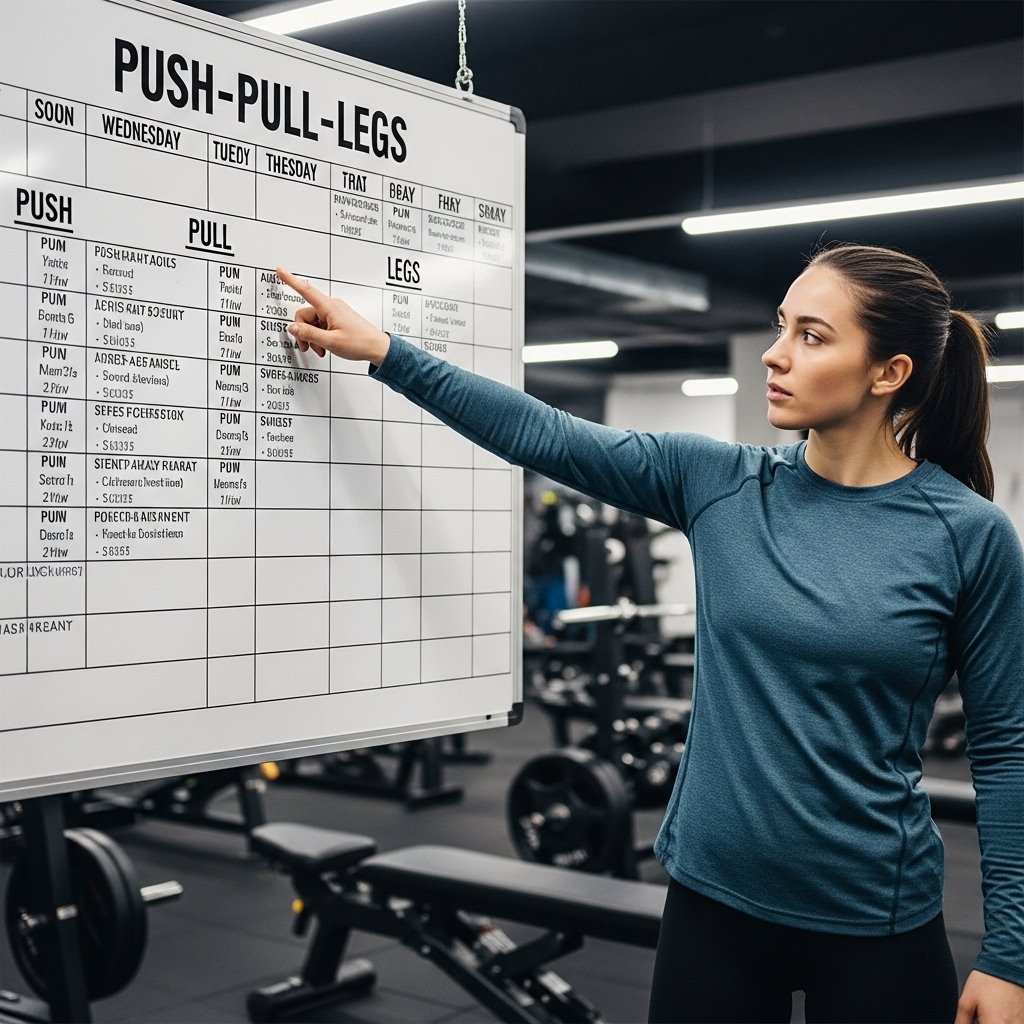
Depending on individual objectives, cardio may be supplemented with this split. After exercises or on off days, light sessions may be effective for some people. Energy and recovery are usually the determining factors between strength and cardio.